Written by —


Written by —
Summit season is again and Snowflake hosted their own Summit between June 1-4 at the Moscone Center. I travelled into San Francisco to hear the latest features at the location and as I'm also as one the Snowflake Data Superheroes in the Nordics, I joined to discuss with my fellow Data Superheroes about the new features and what those mean in Snowflake ecosystem.
Those four days were filled with a lot of announcements, but biggest headlines where that few products got renamed, Snowflake published managed Kafka, the lakehouse went GA and just about everything now has CoCo wired through it. This is my attempt to list all features into a one post (think of this - "these are the updates you should at least know" type of blog). I have added few comments per announcement where I have them.

Image 1: Snowflake founders Benoît Dageville and Thierry Cruanes.
We'll start where most data teams will feel the change first and with the tool I now use daily: Cortex Code.
The CLI agent we've been calling Cortex Code has been rebranded to CoCo at Summit 2026 (because that was the name most of the folks already used).More importantly, it's no longer just a CLI. Snowflake is positioning it as a full AI development platform using the same agent engine, but now reaching across desktop, cloud, Slack, mobile (iOS) and an SDK.
CoCo in Snowsight also got an upgrade. Cloud Agents bring the full agentic runtime into Snowsight where each session can spin up an isolated, Snowflake-managed container behind the scenes. No local setup, no dependency management, no infrastructure to maintain. You get the CLI from any browser.
Inside that container the agent can run shell commands, execute Python, install packages, read and write files, do dbt builds and tests against a dynamically generated Snowflake profile, and search the web for context. The borderline within the CoCo CLI and Snowsight version is getting blurred.
CoCo is coming to Windows and macOS as a native desktop app. The idea is one governed surface for the whole stack: build pipelines, build apps, design agents, debug notebooks and visualize data flows without bouncing between screens. There's also an always-on local agent that holds project context across sessions, so it picks up where you left off.
The CoCo Desktop also supports Automations, which let the user schedule agents to handle recurring work. Think for example a morning routine of checking whether there are any data quality errors within your data platform, or investigating whether sales volumes have changed. Now with Automations you can do those. CoCo Desktop is extensible, which means it supports MCP integrations plus a catalog of skills and plugins. So you can send those data quality errors directly to Slack.
Image 2: On stage Daniela Amodei and Sridhar Ramaswamy discussing about Anthropic and Snowflake partnership
The CoCo Slackbot turns Slack into a governed interface for data work, letting you ask questions, trigger workflows and share results through Slack.
The mobile app (iOS) is the feature I'm most excited about. It is explicitly not a code editor on a phone. It's an agent interface for reviewing and approving: monitoring pipelines, checking scheduled task outputs, approving AI-generated workflows, inspecting logs and asking questions in natural language. Aimed at the moments when something needs a decision and you're not at your desk. You remember those situations at the elevator or in the hallways?
The CoCo Agent SDK packages the same agent loop and tools that power CoCo into an installable library, available in TypeScript and Python. You get programmatic access to the underlying capabilities — querying Snowflake, reading files, running shell commands, searching codebases, executing SQL, editing code.
CoCo is also extending into the tools that you might already use: a VS Code extension, a Microsoft Excel extension, and a plugin for Claude Code.
If you've been using Snowflake Intelligence, it has a new name too: Snowflake CoWork. Where CoCo targets data engineers and builders, CoWork is pitched at every knowledge worker, a personal work agent that sits on top of governed enterprise data.
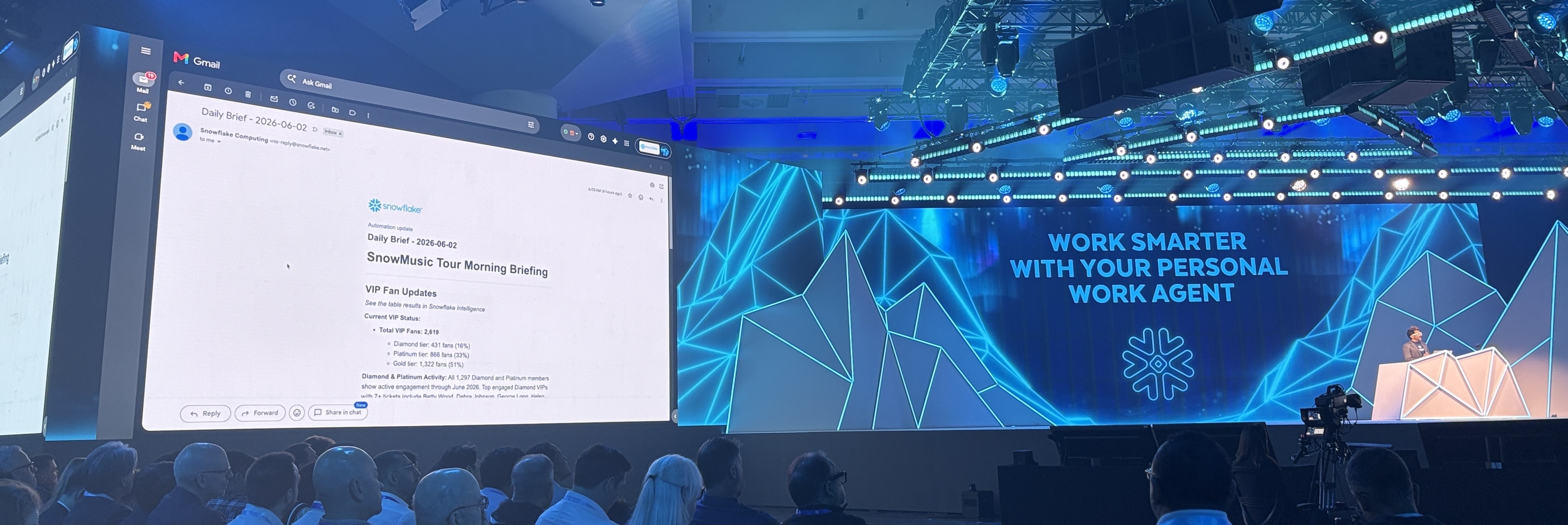 Image 3: Dash DesAI live-demoing Snowflake CoWork
The recurring complaint with enterprise AI is that it takes weeks of configuration before an agent gives useful answers. Cortex Sense is Snowflake's answer: a context layer that learns how your business defines its data automatically. It reads signals from query history, metadata, dashboards in Power BI and Tableau, and data outside Snowflake to infer things like revenue definitions, fiscal calendars and snapshot tables, helping the agent be grounded from day one instead of after a quarter of tuning.
Deep Research tackles questions that need real investigation across structured and unstructured data, using an agent-swarm orchestration approach from Snowflake's AI research team, whereas Analytical Search extends that to unstructured data: aggregation, comparison and trend analysis across large document collections. The example that Snowflake gives is "why is EU gross margin down this quarter": CoWork decomposes it, runs parallel research agents, cross-validates, and returns a cited report in minutes rather than the days a senior analyst would spend.
The updates do not end there. Multi-agent orchestration gives Snowflake CoWork the ability to route each question to the right data, skills and tools automatically, so users don't pick which system to hit. Memory then persists those preferences and recurring patterns across sessions. And User Skills lets anyone turn a multi-step routine into a reusable skill just by describing it in natural language, then share it across the org.
Those skills can then call the Code Execution Tool to produce actual deliverables — PDFs, PowerPoint decks — and of course those skills can be shared within your team.
This is the "agent that checks for you instead of a dashboard you check" section. Automations and time-based subscriptions let CoWork run in the background watching for conditions and anomalies, then alert via email, Slack or mobile. For longer work, the Async Agent API lets agents run tasks that take minutes or hours in the background, so you can hand off a complex investigation and walk away.
CoWork outputs become reusable instead of one-off. Artifacts let you save and share analyses, charts and whole conversation histories with context intact — and they stay live, refreshing with the latest data and respecting each viewer's RBAC. Interactive dashboards in Artifacts let authors publish multi-tile dashboards scoped by RBAC, with follow-up questions asked directly against them. Conversation Sharing shares a thread complete with citations, and a CoWork Slack app brings the agent into Slack with inline charts.
In addition to these updates, CoWork uses MCP connectors and now has an iOS app. All these new features are of course built using the new Agent Studio, the redesigned build-manage-govern surface, with a readiness wizard to move from prototype to production and a single pane for usage, latency, eval scores and tool utilization across every agent in the org.
The setup Snowflake opens with: your head of sales asks an AI agent for Q3 revenue and gets $14.2M; your CFO asks the same thing and gets $12.8M. Same data, different answers, because the business logic lives in different places. That's metric drift, and it's a trust problem.
Horizon Context is the answer: a new capability inside Horizon Catalog that turns catalog metadata into governed business meaning. It's organized around three verbs — collect, enrich, activate.
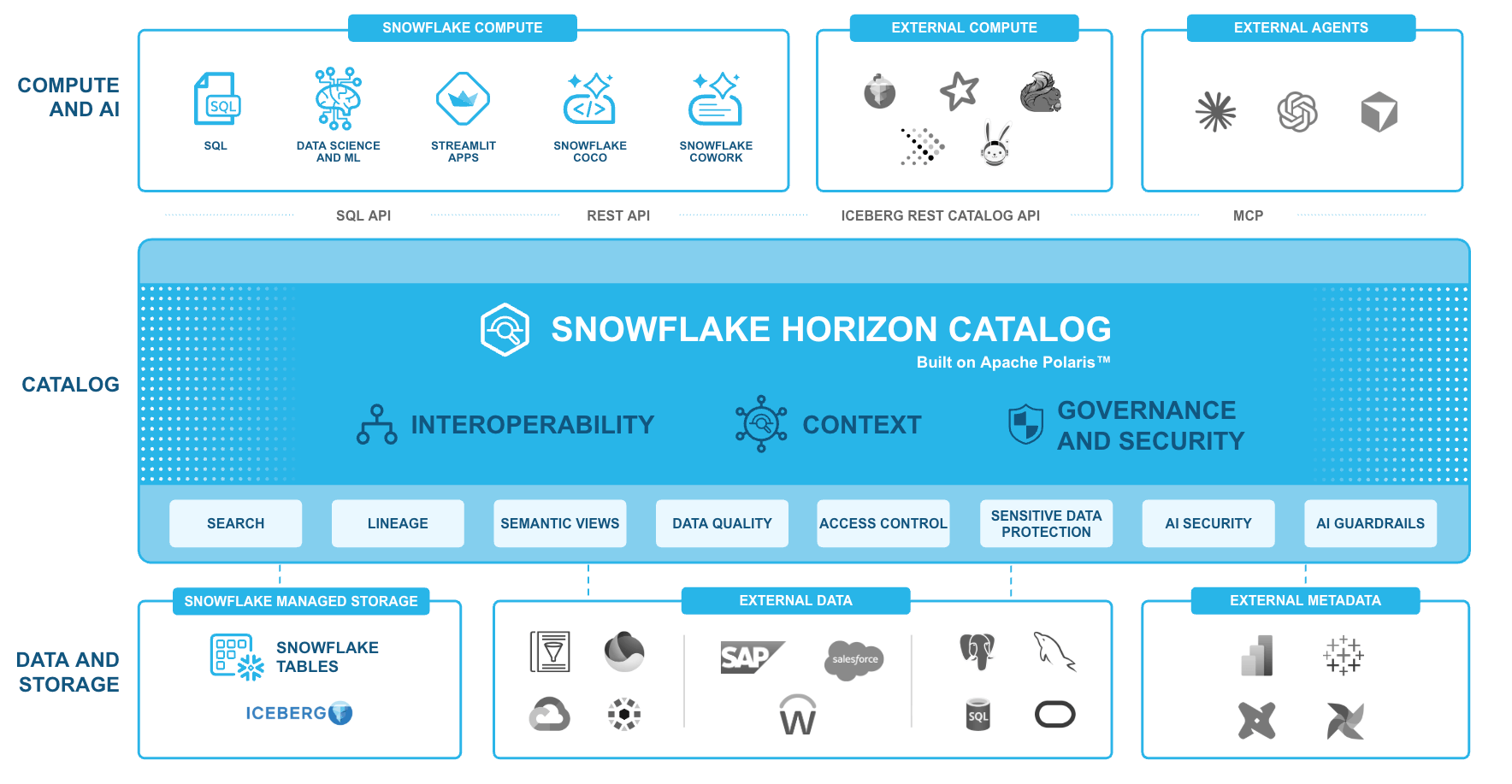
Figure 1: Snowflake Horizon Catalog.
Pull context from the whole estate, not just Snowflake. Metadata Connectors extend Horizon Catalog to external systems such as PostgreSQL, SQL Server, Tableau, Power BI and dbt, collecting schemas, query logs and dashboard definitions. The OpenLineage API lets producers like Airflow send lineage straight into the catalog. And Open Semantic Interchange (OSI) is Snowflake's open standard for exchanging semantic metadata between systems, now with 54 participating vendors and a published spec.
Raw metadata isn't enough; it needs meaning layered on. Horizon Context automates most of that: end-to-end column-level lineage stitched from Snowflake plus external query logs and OpenLineage feeds; a popularity signal from access logs to flag which of several similar assets is authoritative; and AI-generated table and column descriptions.
The semantic-view enhancements are the meat here. Advanced Semantics adds level-of-detail calculations, composable definitions and user-defined materializations with automatic query rewrite. Semantic Studio is an AI-assisted IDE in Workspaces with CoCo and Git integration. And Semantic View Autopilot turns your existing SQL, Tableau and Power BI files into semantic views for you.
Context only matters if it gets used automatically. CoCo retrieves relevant context through Universal Search — hybrid keyword plus semantic search, ranked by popularity and filtered by access policy, now with search across the whole estate. Ask a data question and CoCo automatically finds and queries the right semantic view, falling back to tables if none exists. Semantic views are also exposed over MCP, governed by Horizon Catalog, so you can connect from Claude, Cursor or your agent of choice.
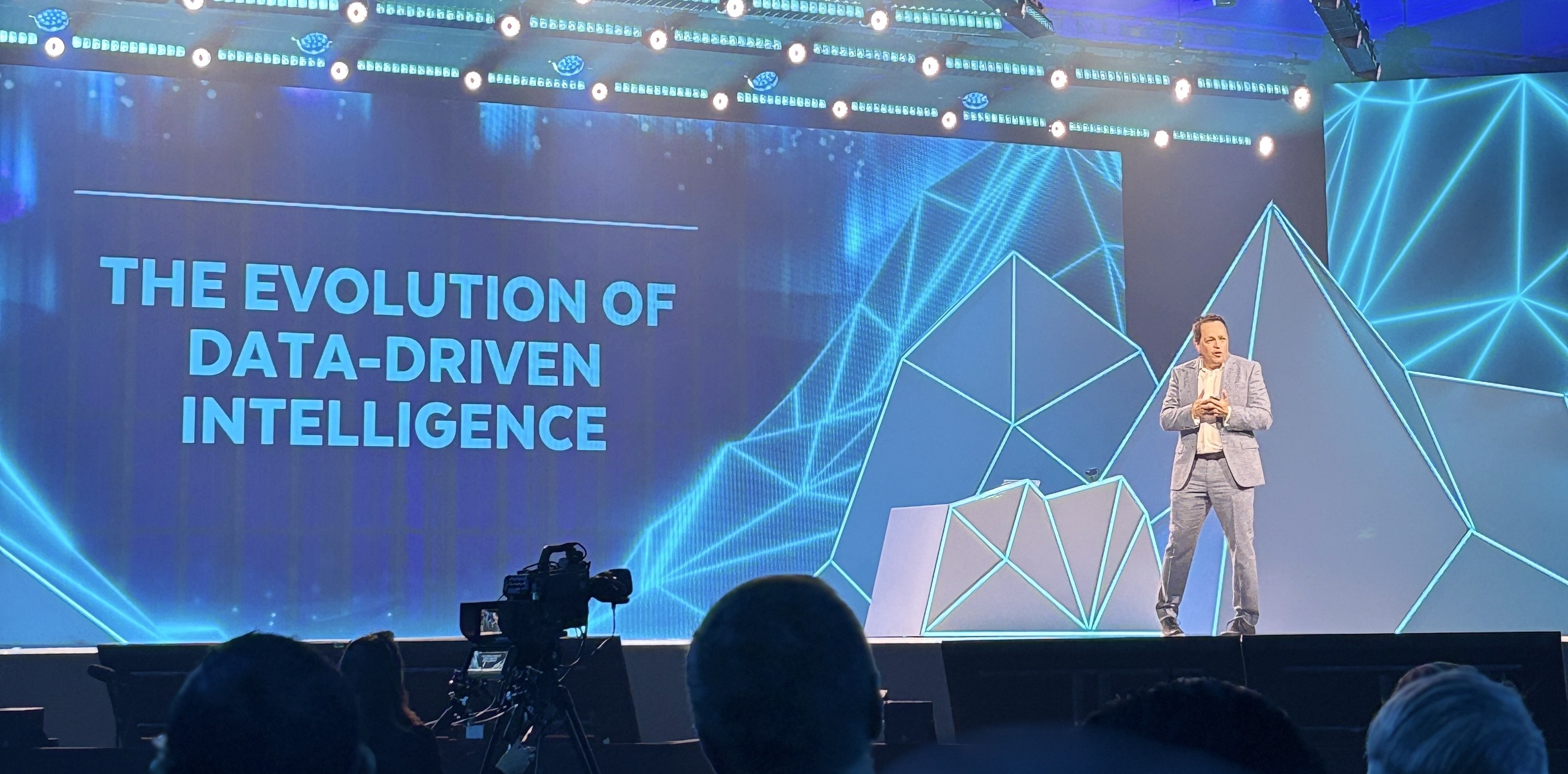
Image 4: Christian Kleinerman listing all the features where CoCo is now embedded.
Agentic AI is only as good as the data feeding it, and by the time most enterprise data reaches the systems meant to act on it, it's already stale. So a big chunk of Summit went to the plumbing getting fresh data in and transformed with less manual orchestration.
Datastream is a native, Apache Kafka-compatible streaming service. The pitch is collapsing the "run Kafka next to your analytics platform" overhead into one governed system: data lands continuously as native Snowflake or Iceberg tables queryable in seconds, with RBAC on topics and Horizon Catalog classification, lineage and masking on tables. Managed Kafka you could say.
Snowpipe Streaming got a batch of enhancements: Kafka Connector 4.0 (up to 10 GB/s per table), SQL-queryable error logging, multi-language SDK, plus Elastic Channels and Durable Acknowledgments for auto-scaling and closing the data-loss window before commit.
Dynamic Tables get up to 2.8x faster refresh and custom incrementalization, which lets you use MERGE or INSERT for transformations that don't fit the declarative model while keeping the automation. DCM Projects also went into public preview.
The agentic era moves the security problem too. Once agents act on your behalf and run code, you need controls built for that. These Snowflake's Summit announcements land directly on role and grant management.
Agent Identity tags every action an agent takes on your behalf with a distinct signal, so agent activity is auditable and its access can be restricted in near real time.
Horizon AI Guardrails is a prompt-injection defense layer built into Horizon Catalog.
CoCo CLI Sandbox isolates CoCo when it runs code, blocking data exfiltration and malicious execution.
Multi-Party Approval (MPA) enforces a four-eyes rule on security-sensitive operations — the one I'd flag for role and grant work.
CoCo security skills handle permissions analysis, role hierarchies, network security and more by natural-language prompt, with an Access Troubleshooter skill for resolving access errors conversationally.
The layer underneath all of it: where data lives and how it's governed across engines. Snowflake's Interoperable Lakehouse (Iceberg, Polaris, OSI) went GA.
Iceberg v3 support is GA, adding VARIANT, row lineage, deletion vectors and geospatial types.
Snowflake Storage for Apache Iceberg makes managed Iceberg as simple as CREATE TABLE, governed through Horizon Catalog.
The Iceberg REST Scan Plan API is the one I'd flag: row-access and masking policies set in Horizon Catalog are enforced even when external engines query the table. Fine-grained access follows the data.
Read and write from external engines is now GA via vended credentials. Spark, Trino and PyIceberg work against the same governed copy your Snowflake users do.
Managed Iceberg replication and failover extends account replication to Snowflake-managed Iceberg. Preview customers saw the new Optimized Refresh run 1.6x–22x faster.
That's a lot of announcements, but as you can see from the updates. The thing that I've been saying for several years, is now true. Snowflake isn't just adding AI features to a data platform anymore; it's building a full-fledged AI data platform. Now with the addition of CoCo applications (Desktop, mobile, CLI) and CoWork make Snowflake even more business friendly. No longer you are tried to Snowsight or depended on your own developers - now everybody can develop on top Snowflake.
In case you though fell that that you might need help in your Snowflake your - don't hesitate to ask help. Recordly can help you on your journey and in case we can't help, we have a huge network of knowledge to tap into.
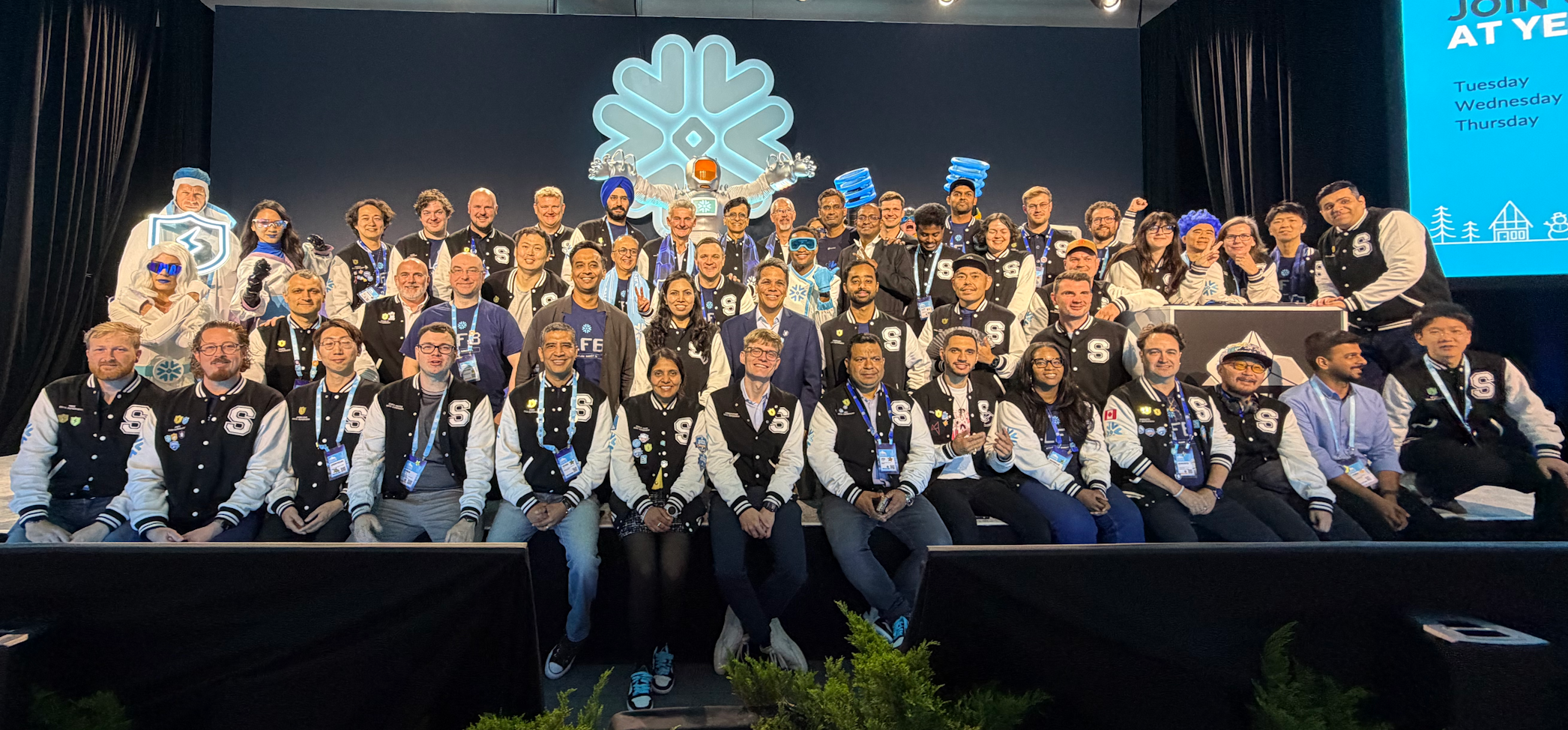 Image 5: Big part of the 126 global Snowflake Data Superheroes.
Written by —