
AI Enhanced Data Teams
AI Agents to make your data development more efficient


Why use agentic AI in data development?
At Recordly, we believe in scaling via automation and agents, and eliminating work that can be delegated to AI.
Due to scarcity of data engineering resources and rising demand of data work in companies, there is a growing need for automating routine data tasks. A significant step in advancing this agenda was the proposal and very fast adoption of MCP (Model Context Protocol), and many products vendors, such as Snowflake and dbt Labs, have launched MCP as part of their products.
Rather than replacing any team members, AI provides an opportunity to amplify what strong data teams can do.
Ensuring your organization's architecture and competencies support the implementation of agentic frameworks is essential for gaining a competitive edge.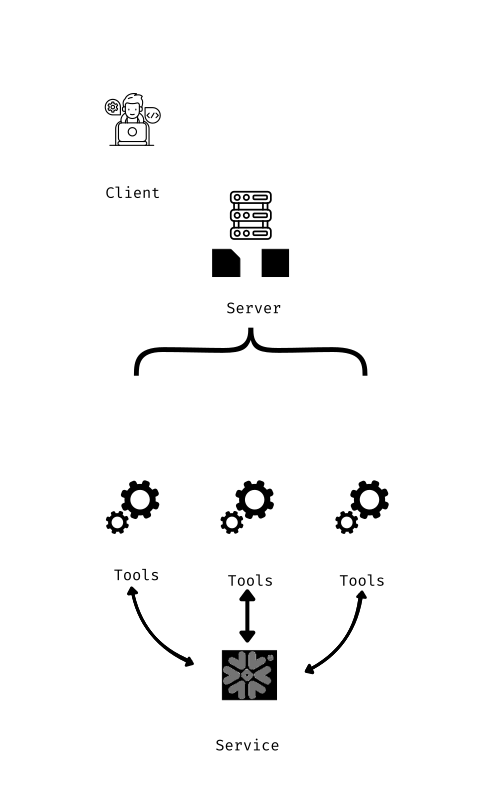
What are MCP-based agents?
LLMs are powerful, but by default they’re stuck inside their own training data and can’t safely act on your systems. The Model Context Protocol (MCP) is an open standard created by Anthropic, the company behind Claude, to fix this problem. MCP is defined as a secure, standardized way for AI applications to connect to external tools, data sources, and services.
The MCP has the following parts:
Client (and host): The thing interacting with the Server, like Claude Desktop or Cursor.
Server: Lightweight program working as the “API”. Exposes a defined set of tools via MCP to work with Services. The server defines resources and tools; the Agent calls them. It works across many clients, enforces allowlists and permissions.
There are both managed or remote servers, and local servers. For example, Github has a perfectly capable remote server, Snowflake has a lot of differences between local and managed, and dbt local and remote are quite close to one another after some major updates.
Tools: A capability for “query data”, “execute SQL”, “list local files”, “run python”. Anything exposing a set of ways to interact with a service.
Services: What the MCP points to:
- Local services: e.g. filesystem, python, duckdb or postgres, Docker, git, etc
- Remote services: Snowflake, dbt Cloud, APIs, GitHub, Azure DevOps.
Compared to traditional retrieval-augmented generation (RAG), which focuses on bringing extra content into the prompt, MCP is about end-to-end interaction and action in your systems.
MCP is already being adopted as a de facto open standard by major AI providers and cloud platforms, which means you’re not locking yourself into a single vendor when you invest in MCP-based agents.

The human-agent cooperation
With agentic AI, data engineering work can be understood as a four-level model, where responsibility shifts from AI agents to humans as complexity increases.
At the top level are complex, high-value problems. These are difficult to define, require deep understanding, and often involve ambiguity. This is where human expertise is essential in shaping the problem, making decisions, and defining the direction that agents then execute on.
The third level is oversight and refinement. Even when results look correct, they need to be reviewed. Humans step in to validate outputs, guide the agents, and refine the results. This ensures quality, correctness, and alignment with business needs.
The second level is routine execution. Here, agents can take on repetitive engineering tasks such as writing SQL, transforming data, or working based on existing logic and patterns. This is where most efficiency gains come from, as agents can scale this type of work quickly and consistently.
At the bottom level, everything depends on well-defined structure. This includes project structure, data models, documentation, guidelines, and high-quality examples. The clearer and more standardized this level is, the better and more reliably agents perform.
Agentic AI Architecture for Data Teams
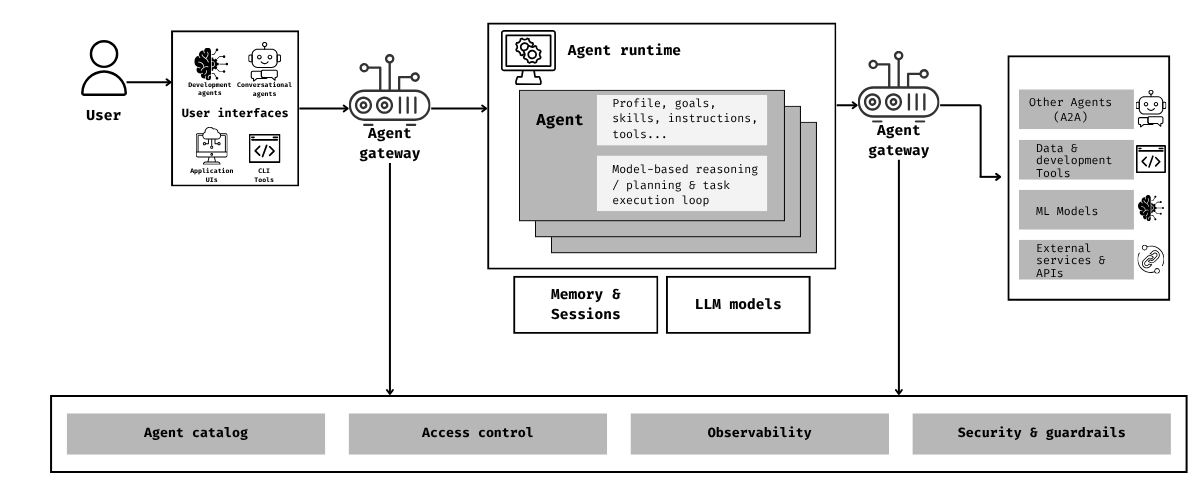
Recordly helps organizations turn agentic AI from concept into production capability. This model shows how MCP-based agents can interact with data platforms, tools, models, and business systems in a secure and governed way. It enables data teams to automate routine work, improve quality, and focus on higher-value decisions.

We make Agentic AI real for your organization
Recordly helps you design and implement MCP-based agents that understand your data, fix issues, automate grunt work, and keep your people focused on the hard problems.
Recordly is the business data company that combines deep data engineering, analytics and platform know-how with hands-on experience building MCP servers and agentic workflows for production environments. Rather than starting with the technology, we first clarify your needs and ownership.
We can help you:
- Identify business cases
-
We help you find opportunities where agents can augment teams, improve data quality, or streamline processes, and then prioritize opportunities by their impact and feasibility.
-
- Evaluate your agentic readiness
- Run a structured readiness assessment across people, process, architecture, and governance
-
Create a clear gap analysis and roadmap: what to fix first, what to automate next, how to prove value safely with measurable milestones, and how agents fit in the roadmap.
- Set up foundations
-
We make your data platform agent-safe and agent-operable
-
Build secure MCP servers that expose your Snowflake, dbt, monitoring, Git, and ticketing systems as safe, composable tools
-
Put guardrails and governance in place so agents don’t become expensive, uncontrolled “fire-and-forget” bots
-
Integrate with your existing stack, so your agents can query data warehouses, trigger jobs, or update business systems through a standard protocol.
-
-
Deliver agentic capabilities
-
Build a PoC and validate the business cases
-
Productionize the valid implementations and implement them end‑to‑end in your environment
-
-
- Realize ROI.
Further reading on agentic AI
Blog: Why Agentic AI is the next evolution of your data platform
Senior data engineer Saku Vaittinen talks about how agentic AI significantly can accelerate large-scale data migrations.
Guide: How to build Agentic workflows for business professionals
Download our practical guide, that includes a workbook, and learn about agentic AI, system prompts, AI skills, and scalable AI workflows.
Blog: The next step in data operations: shifting focus from execution to impact
Mikko Sulonen, Data Architect & CTO talks about the shifting focus on data teams and the recent transformation of data development.
Need help to get started with Agentic AI?
Recordly can help you with all aspects of agentic AI. Partnering with Recordly ensures your stay ahead of your competition utilizing your assets in the most optimal way.
Contact us to get started with agentic capabilities today or book a 15-minute consultation call below.




.jpg)