Written by —

Written by —
🇫🇮 Tämä blogi on alun perin kirjoitettu suomeksi. Löydät suomenkielisen version oikeassa yläkulmassa olevasta kielipainikkeesta.
In many organizations, business and IT still operate somewhat like separate worlds. Both do important work, both are absolutely necessary, yet a gap easily forms between them. And it is precisely in that gap that a surprising number of problems arise.
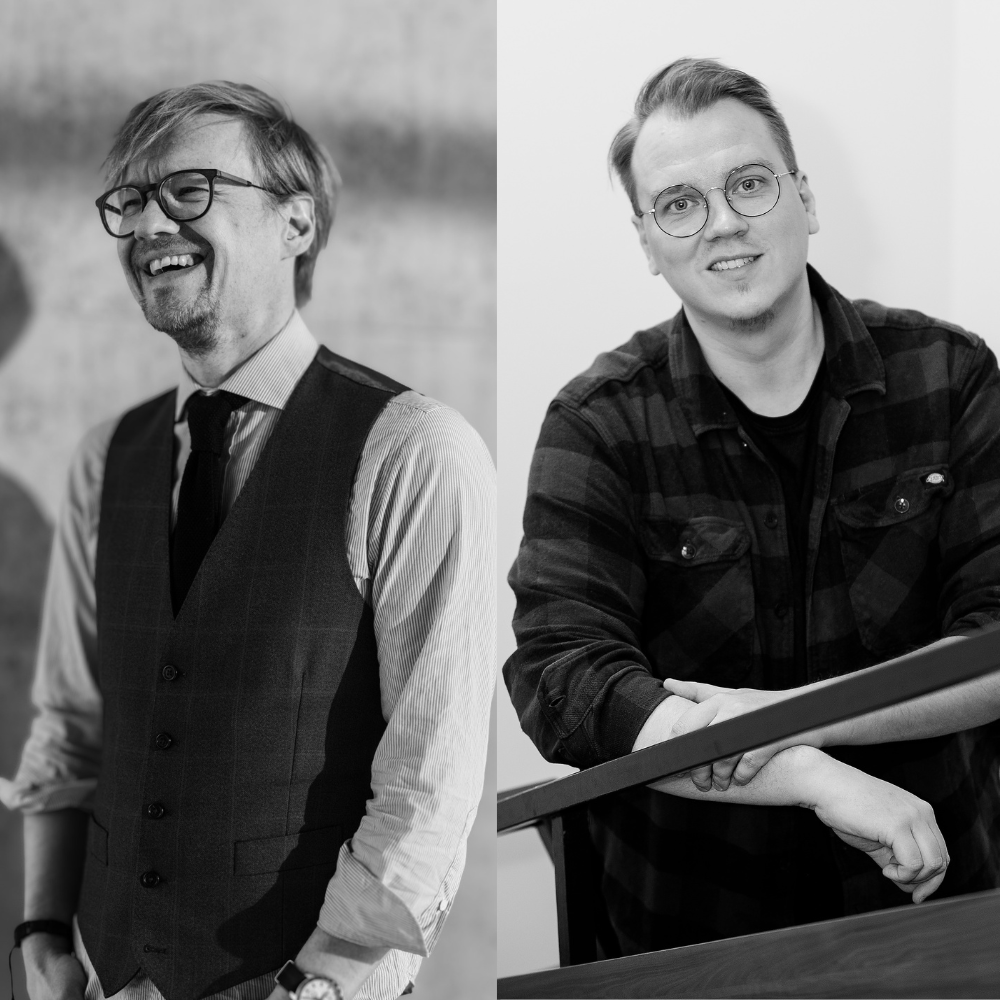
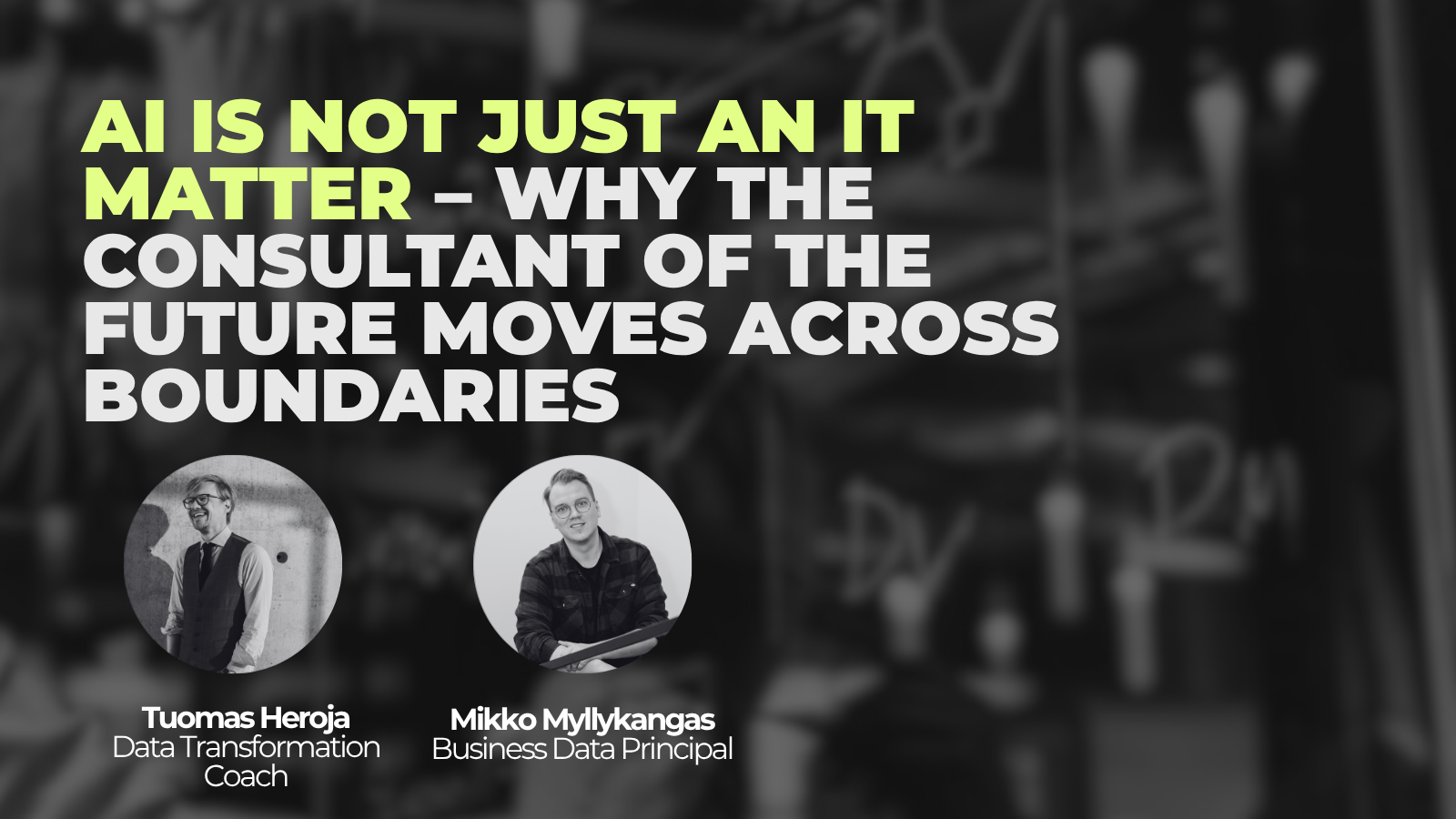
Mikko Myllykangas, Business Data Principal, has always done data, AI, and analytics consulting from the business side, never formally within an IT function. This has given him a vantage point into how business and technology meet, or fail to meet. When he sat down with Tuomas Heroja, Data Transformation Coach, to unpack the topic, their discussion brought up a perspective that feels particularly relevant right now. AI is not just a new set of tools, nor merely a technological upgrade. It forces us to look differently at how a company actually operates. Who understands the need? Who builds the solution? Who owns the change even when things go wrong? And above all: why are these things still so often in separate silos? If ever, now is the time to collaborate and stretch the boundaries of our thinking, even if the previous way of working has allowed people to focus only on their own domain.
The problem is usually not technology, but the boundary. When talking about data, analytics, or AI development, the conversation easily drifts into technology: platforms, infrastructure, models, integrations, and tools. These are, of course, important. But rarely is the biggest bottleneck that something cannot be implemented technically.
More often, the challenge arises because the business need and the technical implementation don’t properly meet. Mikko describes how working at the core of business has given him a clear perspective: the business usually knows best what the real problem is. It understands processes, customers, everyday friction, and where money actually moves. IT, on the other hand, knows how to build solutions securely, scalably, sensibly, and above all, cost-effectively. And cost-effectiveness is more important than it sounds; AI can become surprisingly expensive if not managed carefully. Both are needed. But if these two view the world from their own silos, the result can be a solution that looks good but misses the mark.
You end up with an MVP (minimum viable product) where the “MV” is forgotten. Only the product remains. This is not a new phenomenon, nor even a problem unique to AI. The same pattern has existed for a long time. But AI accelerates it to the point where the old model no longer works as comfortably. One example of where this leads: as AI starts to replace traditional software development, the entire consulting industry must rethink what customers are actually buying. Not hours, not lines of code, but change and value.
Tuomas pointed out a brutal truth: every unit leader has their own metrics. IT is pressured to reduce costs, while business units are driven by performance metrics. That’s understandable, as without metrics, there is no accountability.
But here lies the trap. When everyone optimizes their own domain, the whole becomes suboptimal. You end up in a situation where 1 + 1 is less than 2. No one is doing the “wrong” thing in their own area, yet shared opportunities go unused because leveraging them is not part of anyone’s metrics.
The same logic also makes experimentation harder. Tuomas noted that companies often talk about a culture of experimentation, but in practice, experimentation often means trying something that is expected to succeed immediately. That’s not really experimentation, it’s just a cautious project with a new label. We talk about experimenting, but still reward success. If failure is too expensive, people won’t take risks. And if no one takes risks, nothing truly new is created.
In many companies, the question being asked now is: “How do we benefit from AI?”
It’s an understandable question, but according to both, it comes from the wrong angle. As Tuomas put it, the question easily leads to thinking of AI as a separate entity to which problems can be outsourced, or worse, that there is “our way of working,” and then there is AI, which is given all the boring tasks. At its core, this is the same separation thinking as the business vs. IT divide. The structure remains, even if the tools change.
A better question would be: how should we organize ourselves when AI changes the way work is done?This is a significant difference. If AI is approached merely as a tool that is layered onto existing processes, you end up optimizing the wrong thing. You might automate a couple of steps in a five-step process, but never stop to evaluate the process itself. Is this way of working still sensible? Is the process still justified? Is the problem even the same as it was five years ago?
Mikko suggests that a better approach is to conduct a small audit before automating anything. Look at what processes exist, how they function today, and then consider how new tools could change them. As a byproduct, this can create a surprisingly valuable view of the current state of operations, regardless of whether a transformation is initiated or not.
The real value of AI does not come from neatly writing meeting notes or doing old tasks faster. As Tuomas pointed out, it’s worth considering what value is actually created by generating notes from a meeting that should never have been held in the first place, or that was low quality. Efficiency in the wrong place is not efficiency. Value is created when we dare to rethink structures, ownership, and division of work.
Mikko described well how the role of a consultant is changing. Traditionally, a data or technology consultant has been seen as a strong specialist, someone who deeply understands a specific technology. And yes, these people are still needed. Without deep expertise, functioning solutions cannot be built.
But it is no longer enough on its own. Increasingly, we need people who simultaneously understand business, processes, and technology. Not in the sense that they must be the best in everything, but in that they can move between these worlds, ask the right questions, and build shared understanding. They don’t sit purely in IT or purely in business. They operate in the space in between, where most real problems actually exist.
Mikko’s unofficial title for this role would be “general troublemaker,” the more formal version being change agent. The value of this role lies in going where problems actually tend to live: at the interfaces. Between two teams. Between two units. Between business and IT. Tuomas added that it is often precisely there that the most valuable questions emerge: “Why is this done this way?” or “What problems haven’t we even noticed yet?”
Tuomas described this as an Indiana Jones–style approach: not searching for ready-made answers, but for lost treasure, problems that no one has yet been able to name. And once a problem is found, it is already half solved.
This leads to a major challenge that both recognize: this kind of work is incredibly difficult to measure. When someone builds a dashboard, an integration, or a model, the result is visible. It is easy to report. But how do you measure the value of someone stepping in, asking a few smart questions, connecting the right people, clarifying the goal, and preventing a project from going in the wrong direction for three months?
Tuomas shared a concrete example from his work: in one project, lead time dropped to a quarter without AI, without additional budget, and without overtime. One major change was that people started talking more about the things that actually mattered. From a business perspective, that’s a huge result. And yet the work behind it may outwardly look like someone “just talking to people.”
Here lies one of the major paradoxes in modern organizations, as Mikko pointed out: the most important development work often comes from activities that Excel doesn’t handle well. It doesn’t fit neatly into a single cost center. And this is not accidental. Structures are designed a certain way because those responsible for budgets want to report in a certain way. The logic of reporting starts to drive the work, even though it should be the other way around. It doesn’t immediately look like a tangible output. And yet it can speed up work, reduce inefficiency, and improve decision-making more than many more visible efforts. This also ties into how development work is funded: if everything must be tied to a single project and a single owner, much of the cross-functional work simply doesn’t get done.
Tuomas introduced the concept of an “Italian strike.” It refers to a situation where factory workers do exactly what their job description states, nothing more, nothing less. No one is officially striking. Yet production drops by half, because no factory or organization actually functions based solely on formally defined roles.
A functioning community, whether a factory, an office, or a consulting team, inevitably relies on people being flexible, communicating, helping each other, and informally crossing boundaries. This does not mean everyone should do everything, nor does it mean that core responsibilities disappear. But it does mean that organizations need people who both have the permission and the ability to look beyond their own domain. And that is exactly what the consultant of the future, or any development role, should provide.
What should be done? And how should it be done?
These two questions are constantly being explored in organizations, with or without AI. And importantly, feedback from the work itself guides what should be done next. This is not about two separate questions, but a continuous loop: do, learn, adjust. But now AI forces us to ask them again, more carefully and more boldly.
It is not enough to do the right thing in the wrong way. Nor is it enough to do the wrong thing very efficiently. The winners of the future will not be the organizations with the best tools alone, but those that can combine depth and breadth, allow people to cross boundaries, and pause to ask even the “stupid” questions. Often, that is where the most important change begins.
Perhaps the most important consultant of the future is not the one who already knows all the answers. Perhaps it is the one who helps the organization find better problems and solve them in the right way.
Written by —